
A distributor in Lagos pays a supplier in Nairobi. The naira leaves one account, the shillings land in another, and somewhere in between, the money usually becomes dollars first. That middle step is where the fees, the delays and the hunt for scarce dollars live.
The Pan-African Payment and Settlement System, PAPSS, was built to cut that step out. Its pitch is simple: pay in your currency, get paid in theirs. But the dollar doesn’t vanish completely. It shrinks, and how much it shrinks is the part a finance team should understand.
Next week, PAPSS and the National Bank of Ethiopia host PAPSS COWRY 2026 in Addis Ababa on 26 and 27 November (Afreximbank). Fincra is a platinum sponsor. This piece explains what local-currency settlement means in practice, and what to ask before you route money through it.
How a payment between African currencies usually moves
Most African banks don’t hold accounts with each other. So when a Nigerian bank sends money to a Kenyan bank, it goes through correspondent banks, often outside the continent, and through a hard currency, usually the US dollar. When PAPSS launched in January 2022, Afreximbank said over 80% of cross-border payments from African banks were routed offshore this way (Afreximbank launch release, via HapaKenya).
That route costs money at every stop. Sending $200 into sub-Saharan Africa cost an average of 8.45% in 2024, the highest of any region (AfricaNenda, SIIPS 2025). And it needs dollars in the first place, which can be hard to get when local liquidity is tight.
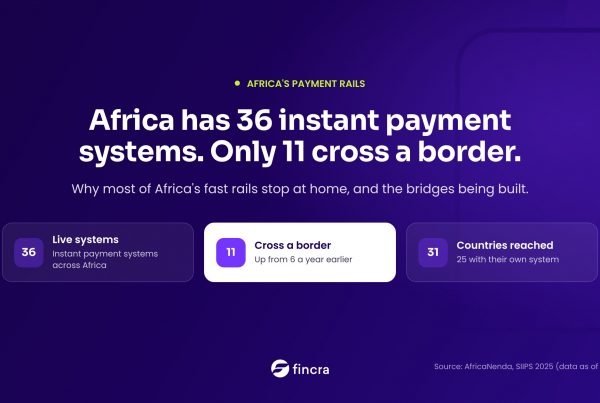
We covered why most of Africa’s fast domestic rails stop at the border in Africa has 36 instant payment systems. Only 11 cross a border. PAPSS is one of those 11.
How PAPSS local currency settlement works
PAPSS runs in two stages: the payment, which takes seconds, and the settlement between countries, which happens once a day (PAPSS, How it works).
Stage one: the payment.
- The payer tells their bank to send naira.
- The bank passes the instruction to PAPSS, which checks it.
- PAPSS forwards it to the receiver’s bank in Kenya.
- The receiver’s bank credits the supplier in shillings. PAPSS says this happens within 120 seconds.
No dollars move at this stage. To make that possible, each bank pre-funds an account in its own currency at its central bank before it can send.
Stage two: the settlement. Every day at 11:00 UTC, PAPSS adds up what each country’s banks sent and received, and works out one net figure per central bank. Only that net figure settles in hard currency, through accounts the central banks hold at Afreximbank. PAPSS aims to settle within 24 hours.
Here’s why that matters, using made-up numbers. Say Nigerian banks send the equivalent of $10 million to Kenya in a day, and Kenyan banks send the equivalent of $7 million back. If every one of those payments went the dollar route, $17 million would change hands in dollars. Under PAPSS, only the $3 million difference settles in hard currency. Customers on both sides never touch a dollar.
PAPSS puts the effect at up to an 80% cut in foreign exchange needs per transaction, with cost savings of 92 to 95% (Afreximbank, September 2026). Those are PAPSS’s own figures, and it hasn’t published the method behind them.
How big PAPSS is now
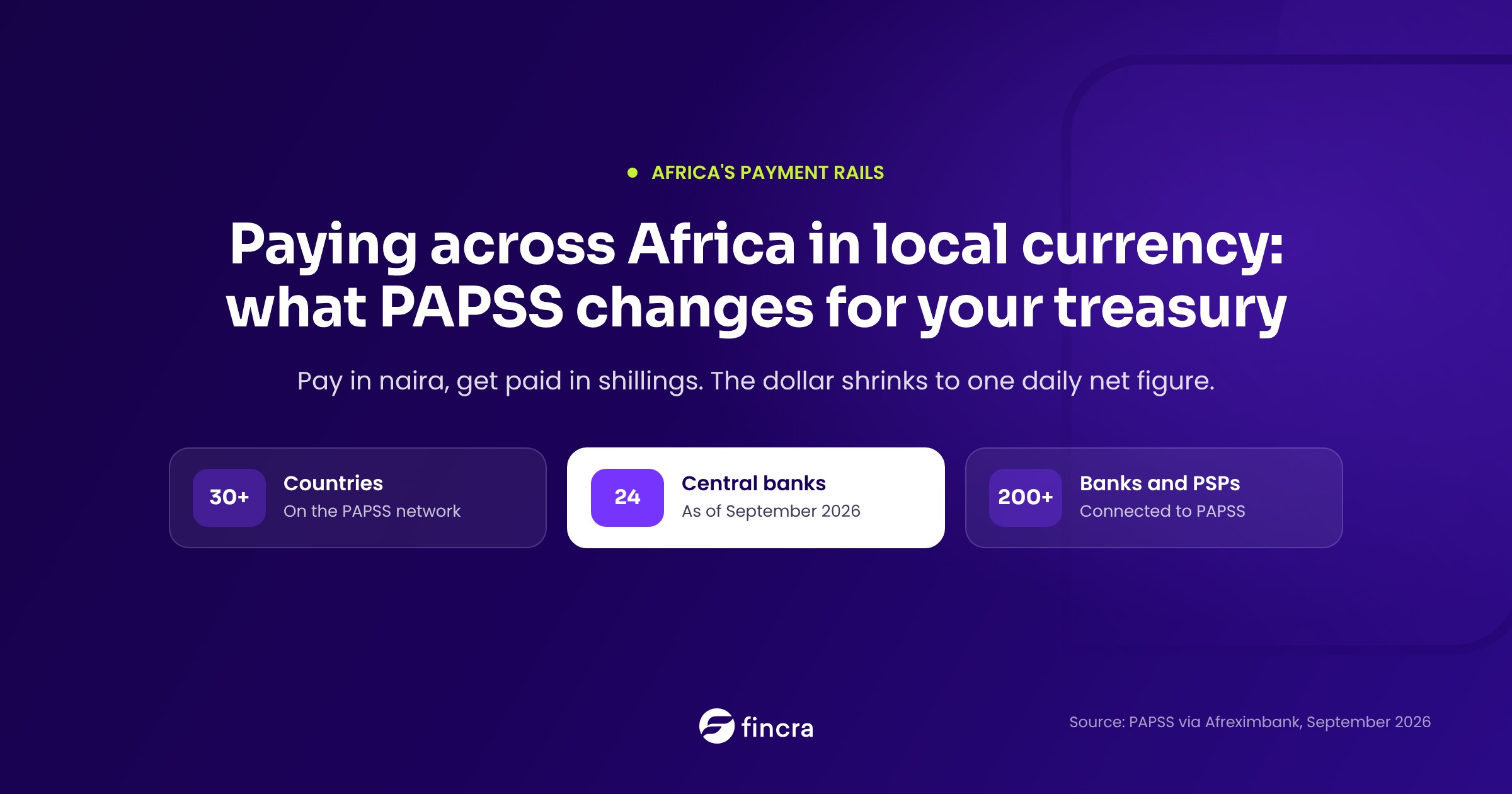
In September 2026, PAPSS said it operates in more than 30 countries and connects 24 central banks, more than 200 commercial banks and payment providers, and 16 switches. It said transaction volumes rose about 1,000% and values about 120% against the same period in 2025, without giving the base figures (Afreximbank, September 2026).
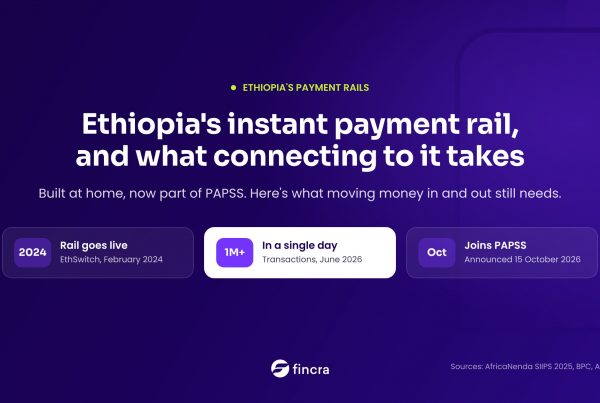
Kenya is a good example of how it reaches further. Since February 2026, more than 80 banks, fintechs, SACCOs and telcos on Kenya’s Pesalink switch can receive PAPSS payments into bank accounts and mobile money wallets (PAPSS). Ethiopia’s central bank joined PAPSS in October 2026, as we covered in Ethiopia’s instant payment rail, and what connecting to it takes.
What it changes for a finance team, and what it doesn’t yet
If you pay suppliers or staff in other African countries, three things change when a payment goes over PAPSS:
- You stop sourcing dollars for every payment. You pay in your own currency. The dollar settlement happens between central banks, on the net amount only.
- The receiver gets paid in minutes, not days. That matters for suppliers who ship only once paid.
- You can swap currencies directly. PAPSS’s African Currency Marketplace lets eligible companies and banks trade one African currency for another without going through dollars. In its 2025 pilot, more than 80 African companies traded across 12 currency pairs (PAPSS).
Before you plan around it, check four things:
- Is your bank actually live? Being connected and offering it to customers aren’t the same thing. PAPSS itself says its next phase, from 2027, is about “activating” the network it has built (Afreximbank, September 2026).
- Is the other side live? Your supplier’s bank or wallet provider has to be on PAPSS too.
- What rate and fee will you pay? PAPSS doesn’t publish how the exchange rate on a payment is set. Ask your bank for the rate, the fee and any limits before you commit volume.
- Which rules still apply? Each country’s foreign exchange rules still apply on PAPSS, including documentation and limits. Faster rails don’t change what your bank needs from you.
PAPSS doesn’t remove the dollar from African trade. It moves it out of your hands and shrinks it to a daily net figure between central banks. For most businesses, that’s the part that hurt.
Where this leaves you
Local-currency settlement is one of the few changes in African payments that goes straight to a finance team’s biggest headache: finding dollars to pay someone who doesn’t want dollars. The rail exists. The work now is getting banks, wallets and businesses to use it.
At Fincra, we connect businesses to local payment rails across African countries through one API, for collections, payouts and FX. We’ll be at PAPSS COWRY 2026 in Addis Ababa on 26 and 27 November as a platinum sponsor. Come find us at our booth.