
Pay your landlord in Lagos and the money clears before you’ve put your phone down, carried by one of Africa’s instant payment systems. Pay a freelance designer in Kigali for a logo, and the same money can take days, pass through a dollar conversion and lose a slice at every stop. Sending $200 into sub-Saharan Africa cost an average of 8.45% in 2024, the highest of any region (AfricaNenda).
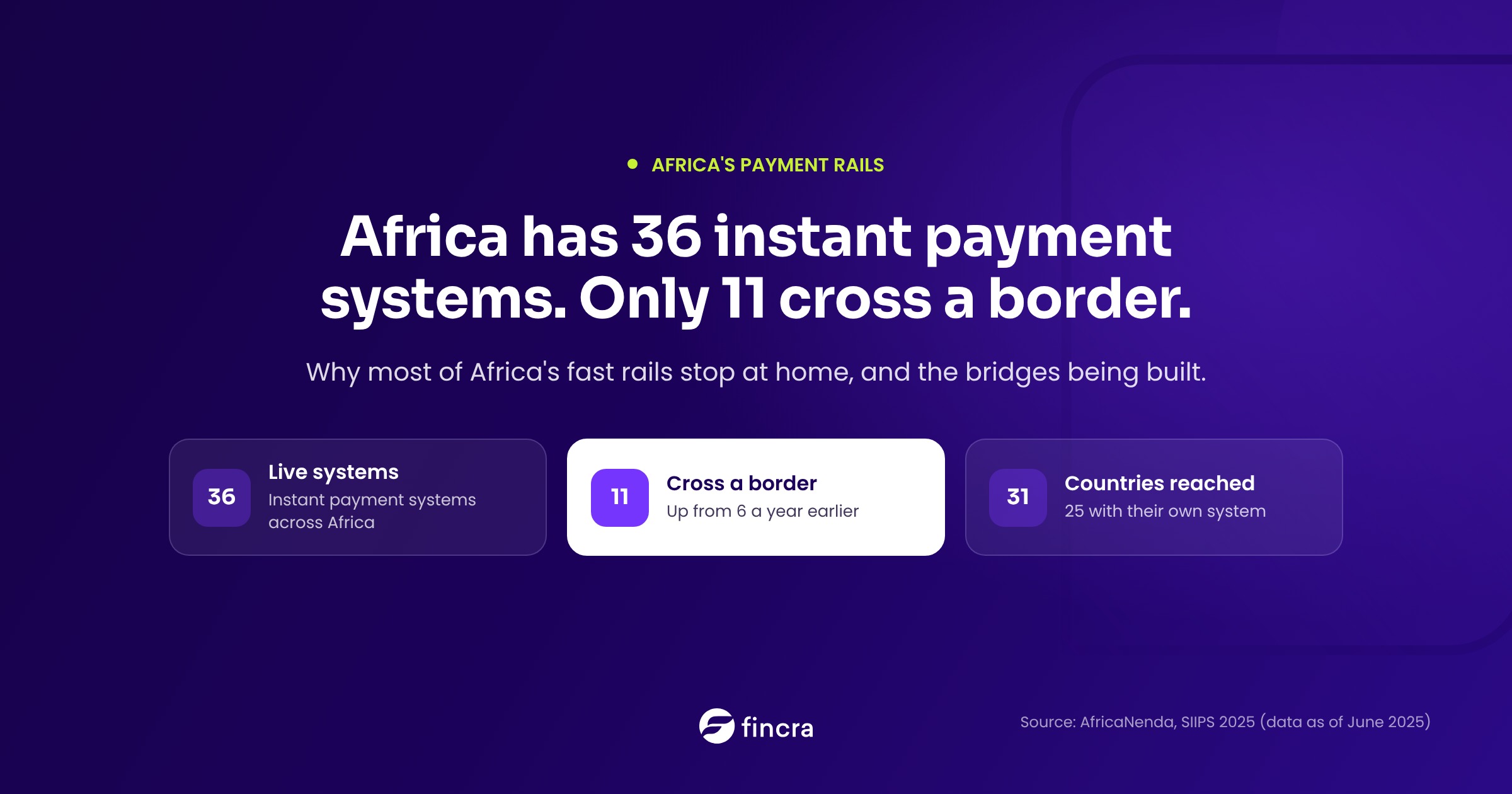
That gap isn’t about technology. Africa now runs 36 live instant payment systems, the kind of rail that makes a local transfer feel instant. According to AfricaNenda’s latest count, only 11 of them can carry a payment across a border (AfricaNenda).
That number is moving, though. It was six a year earlier. This piece looks at why most of Africa’s instant payment systems stop at the border, and what is pushing them across.
What an instant payment system is
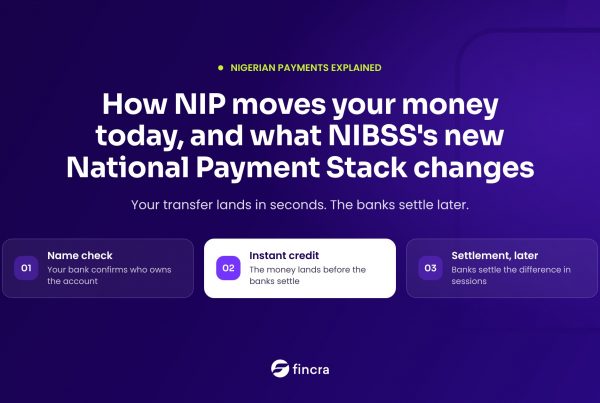
An instant payment system (IPS) is the shared rail that moves money between banks, mobile money providers and fintechs in seconds, any time of day. If you live in Nigeria, you use one every time you make a bank transfer: NIP, run by NIBSS. We walked through how a single NIP transfer moves in how a Nigerian bank transfer actually moves.
Most of these systems were built for one country, one currency and one set of rules. That’s why they’re fast at home. It’s also why they stop at the border.
Instant payment systems in Africa, by the numbers
AfricaNenda tracks these systems every year in its State of Inclusive Instant Payment Systems report. The 2025 edition, published in November 2025 with data as of June 2025, is the latest (SIIPS 2025 report).
| Measure | Mid-2024 | Mid-2025 |
|---|---|---|
| Live instant payment systems | 31 | 36 (33 domestic, 3 regional) |
| Systems that can send cross-border | 6 | 11 |
Those 36 systems reach 31 countries: 25 have their own domestic system, and six more in Central Africa get access through the regional GIMACPAY (SIIPS 2025 report).
The 11 that cross borders are IPN and Meeza Digital in Egypt, Kenya Mobile Money, Madagascar Mobile Money, MauCAS in Mauritius, Tanzania Mobile Money, the three regional systems (GIMACPAY, PAPSS and TCIB), and two from Nigeria: NIP and eNaira. So the rail behind your everyday Nigerian bank transfer is already one of the few that can reach past the border.
In 2024, the systems that shared data carried 64.6 billion transactions worth $1.98 trillion. Volumes have grown about 35% a year since 2020 (SIIPS 2025 report).
So the rails are busy. The money just mostly stays at home.
Why most of Africa’s instant payment systems stop at the border
A domestic transfer has one currency, one regulator and one rulebook. A cross-border one has two of each, plus a currency conversion in the middle. AfricaNenda names five things that get in the way (SIIPS 2025 executive summary):
- Different customer checks. Know-your-customer and anti-money-laundering rules differ from country to country, so the same sender can pass in one place and fail in another.
- Different message formats. Two systems that format a payment differently can’t read each other’s instructions without translation.
- No clear business case. Payment providers aren’t sure cross-border volumes will pay for the work of connecting.
- The US dollar in the middle. Exchange rates and settlement get harder across currencies, especially where corridors still depend on dollars and liquidity is tight.
- No shared rulebook. Countries have to agree who is liable when something goes wrong, and that takes time.
Think of it like two cities with great roads that end at a river. The cars are fast. What’s missing is the bridge, and somebody has to agree who pays for it and which side of the road to drive on.
The bridges being built between Africa’s instant payment systems
The jump from six to 11 cross-border systems didn’t happen by accident. Three kinds of bridge are going up.
Regional systems. AfricaNenda counts three live regional instant payment systems: GIMACPAY in Central Africa, TCIB in Southern Africa and PAPSS across the continent. Together they reach 22 countries (SIIPS 2025 report). In West Africa, the central bank of the eight UEMOA countries launched PI-SPI, a shared instant payment platform, on 30 September 2025, after AfricaNenda’s data window closed (BCEAO).
PAPSS growing up. The Pan-African Payment and Settlement System lets businesses pay across African borders in local currencies, without routing through dollars. In September 2026, PAPSS chief executive Mike Ogbalu III told journalists in Lagos that the network now reaches more than 30 countries, 24 central banks and over 200 commercial banks and payment providers, and that transaction volumes were up about 1,000% on the same period in 2025 (Techeconomy). By July 2026, the Bank of Central African States had joined, bringing in the six CEMAC countries (Launch Base Africa).
Domestic rails getting ready to talk. Message formats are one of the barriers, and AfricaNenda recommends ISO 20022, a shared international standard for payment messages, as part of the fix. Nigeria’s new National Payment Stack is built on it, as we covered in our NIBSS piece. Tanzania showed what happens when providers inside one market connect, in our post on Tanzania’s mobile money interoperability.
Meanwhile, businesses aren’t waiting
None of this means money doesn’t cross African borders today. It does, just not on these public rails. Businesses that can’t wait for the bridges find their own way over, usually one of three:
- The bank route. A wire through correspondent banks, often converting through dollars on the way. It works almost everywhere, but every bank in the chain can add a fee and a delay.
- Stitching partners together. A collections partner in one country, an FX provider in the middle, a payout partner in the other. Each one is a separate contract, a separate fee, a separate reconciliation file and one more place a payment can get stuck.
- Stablecoins. Digital dollars that move on a blockchain in minutes. Chainalysis’s latest regional report, published on 29 October 2026, says cross-border stablecoin transfer volumes in sub-Saharan Africa increased nearly fivefold (Chainalysis). Businesses turn to them when they can’t get dollars locally: Yellow Card’s CEO has described a major food producer paying overseas suppliers in stablecoins (Chainalysis). The catch is at the edges: someone still has to turn local currency into stablecoins at one end and back again at the other, under each country’s rules.
These routes work, and plenty of businesses run on them. But they’re workarounds for the same gap this piece is about. The more instant payment systems connect across borders, the fewer partners a payment needs to pass through.
What this means for businesses
If you pay suppliers or staff in other African countries, the number to watch isn’t 36. It’s 11, and how fast it grows. Every new bridge is a corridor where money can move on a shared rail, in local currency, instead of through a chain of banks and dollar conversions.
If you run payments for a platform, the work is shifting. Connecting to one country’s rail used to be the whole job. Now the question is which regional systems your partners connect to, and which corridors they actually cover today, not on a roadmap.
If you run finance, the barriers AfricaNenda lists are the same ones that show up on your reconciliation sheet: a payment that converted twice, a transfer held for a compliance check, a fee nobody quoted upfront.
The bridges will take years to finish. Until then, the real choice is how many partners you want to stitch together to get a payment home.
At Fincra, we connect businesses to local payment rails across African countries through one API, for collections, payouts and FX, so one partner covers the corridor instead of three. See how Fincra works.