
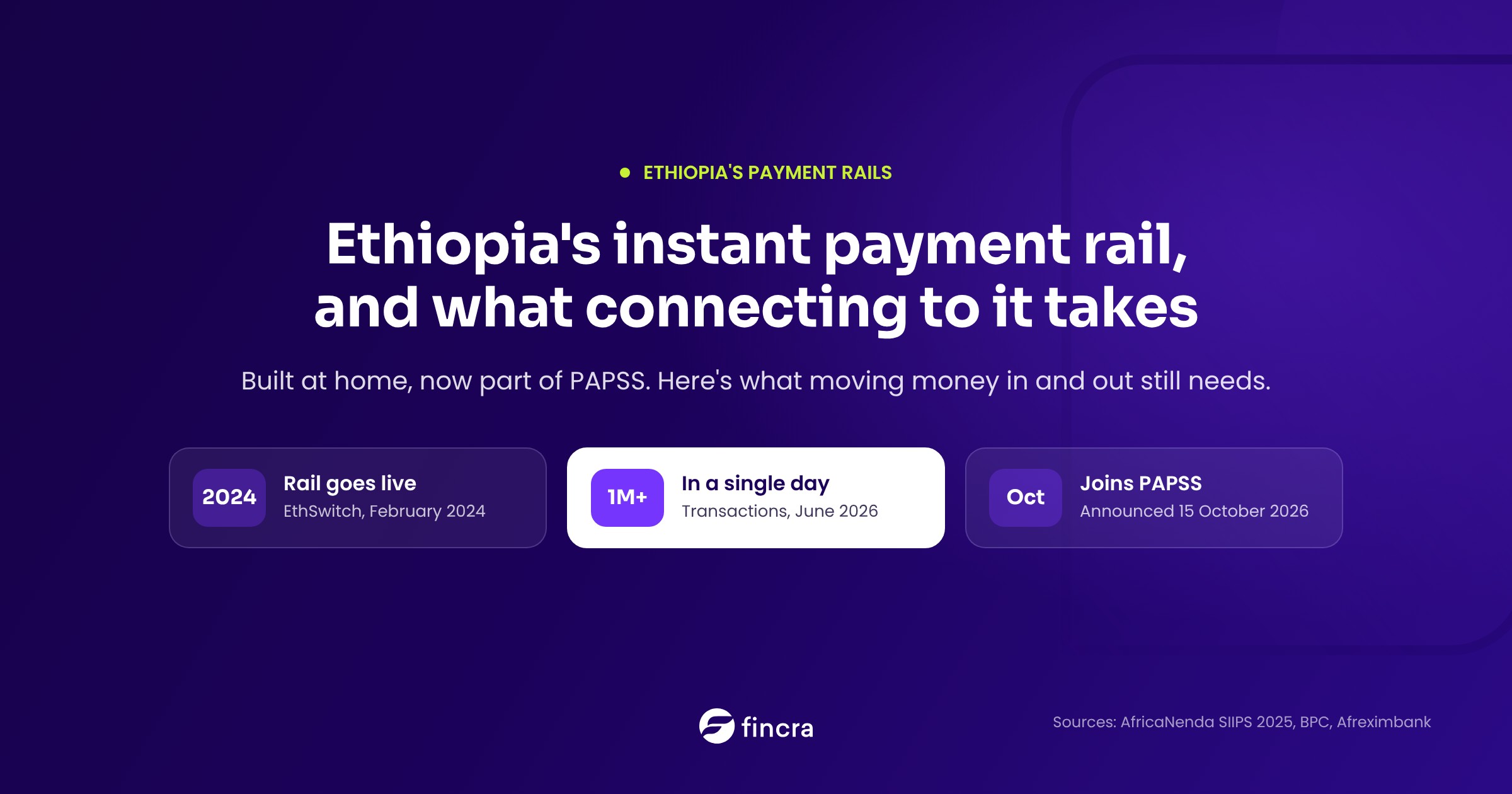
A few years ago, an Ethiopian who wanted to send money from one bank’s app to a friend at another bank often had to go over the counter at a branch instead. That has changed fast. By June 2026, Ethiopia’s instant payments platform had handled more than one million transactions in a single day (BPC).
At the same time, Ethiopia is opening up. It floated its currency in July 2024, passed a law letting foreign banks in, and in October 2026 its central bank joined PAPSS, the pan-African payment network. Later this month, Addis Ababa hosts PAPSS COWRY 2026, and Fincra is a platinum sponsor, with a booth on the floor.
This piece looks at how Ethiopia’s instant payments rail was built, what has opened, and what it still takes to move money in and out.
How Ethiopia’s instant payments rail was built
Ethiopia’s rail is run by EthSwitch, a company the National Bank of Ethiopia set up in 2011 with the country’s banks and microfinance institutions. It started with ATMs in 2016 and card payments in 2020. Mobile banking and wallets still worked as closed loops, so moving money between them meant a branch visit (SIIPS 2025 EthSwitch case study).
The fix was an instant payment system built on ISO 20022, the international message standard. It went live in February 2024 (SIIPS 2025 EthSwitch case study). In December 2025, EthSwitch put it under one national consumer brand, EthioPay, which replaces the “Other Bank” option in mobile banking apps (Capital).
What it does today, according to EthSwitch’s technology partner BPC (BPC):
- Real-time transfers between bank accounts and wallets
- Payments to a phone number or short username instead of an account number
- One national QR code that works across banks and wallets
- Request-to-pay, recurring payments, and bulk and trade payments
The numbers have followed. In June 2026, BPC said the platform had passed one million transactions in a single day, worth more than 5 billion birr.
A market that is opening, slowly
Two big changes came before the payments story.
The birr floated. On 29 July 2024, the National Bank of Ethiopia moved to a market-based exchange rate. Banks can now buy and sell foreign currency at negotiated rates (EY). The same directive required exporters to convert half of their export earnings into birr (NBE Directive FXD/01/2024). Since February 2026, service exporters can keep all of theirs in foreign currency (NBE Directive FXD/04/2026).
Foreign banks can come in. A new Banking Business Proclamation, No. 1360/2025, took effect in March 2025. Under the central bank’s licensing directive, a foreign bank can open a subsidiary or branch with at least 5 billion birr of capital, paid in foreign currency (NBE Directive SBB/94/2025). Foreign investors can also buy stakes in existing Ethiopian banks, within ownership limits the central bank sets (Capital).
The door is open, but few have walked through yet. As of September 2026, no foreign commercial bank was operating in Ethiopia. The central bank says two foreign banks have applied to set up new banks, and it hasn’t named them (Capital).
Ethiopia’s instant payments and the rest of Africa
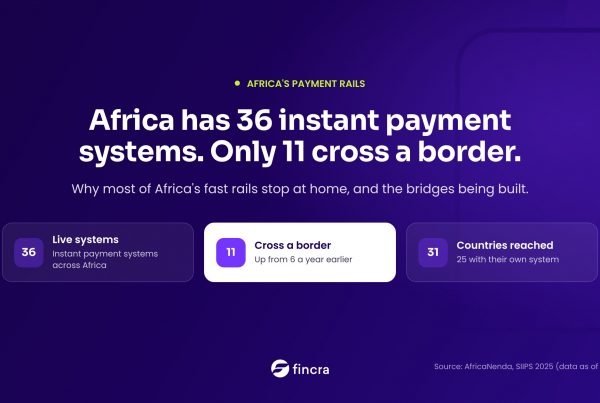
Inside Ethiopia, the rail now connects. Across the border, it mostly doesn’t yet. EthSwitch wasn’t among the 11 African instant payment systems that could send money across a border as of June 2025 (SIIPS 2025 report). At the time, it had cross-border projects under way, including a link with the UAE’s Aani system and talks with PAPSS (SIIPS 2025 EthSwitch case study).
Those talks have moved. On 15 October 2026, Governor Eyob Tekalign of the National Bank of Ethiopia and PAPSS chief executive Mike Ogbalu III announced that Ethiopia had officially joined PAPSS. In their words, this “will enable” Ethiopian financial institutions to connect and make cross-border payments (Afreximbank). So joining is the first step: each bank still has to connect, and the announcement doesn’t say whether any is live yet.
Mobile money may follow. Ethiopia’s mobile money operators are preparing to connect to PAPSS, though each needs a letter of no objection from the central bank first, and no date has been set (Capital).
Addis Ababa hosts PAPSS COWRY 2026 on 26 and 27 November at the Ethiopian Skylight Hotel, co-hosted by PAPSS and the National Bank of Ethiopia (Afreximbank).
What it still takes to move money in and out
For a business outside Ethiopia, the domestic rail is the easy part. Getting money across the border still runs into four things.
- Currency rules. The birr now floats, but goods exporters were required to convert half of what they earn abroad into birr, and only service exporters have since been allowed to keep all of it (EY). If you’re paying an Ethiopian supplier, check the current rule with their bank: it shapes how and when they want to be paid.
- Banks connecting one by one. PAPSS membership opens the door to paying in local currencies, but only once each Ethiopian bank is connected to it (TechTrends).
- Wallets waiting on approval. Mobile money operators need the central bank’s sign-off before linking to PAPSS (Capital).
- No foreign banks on the ground yet. Until the first foreign banks are licensed and operating, international businesses work through Ethiopian banks (Capital).
What this means for businesses
If you sell into Ethiopia, the domestic side is ready in a way it wasn’t three years ago. Customers can pay from any bank or wallet, by phone number or QR code, and request-to-pay and recurring payments are live.
If you buy from Ethiopia, watch the border, not the rail. PAPSS membership is the first real path to paying Ethiopian suppliers in local currency, but it only works corridor by corridor as banks connect.
If you’re weighing a presence there, the rules are written but the market is early: the capital bar is high, and no foreign bank has opened its doors yet.
The next few months will show how fast the pieces join up. COWRY in Addis Ababa on 26 and 27 November is a good place to see which banks are ready. Fincra is a platinum sponsor of COWRY 2026: come and find our booth at the Ethiopian Skylight Hotel.
At Fincra, we connect businesses to local payment rails across African countries through one API, for collections, payouts and FX. See how Fincra works.