
Paying a supplier in China from Africa is one of the oldest problems in trade, and one of the clunkiest. To pay China with stablecoins is now one of the ways people do it, and the volume is no longer a fringe experiment. Here is the tension I keep coming back to.
Nigeria alone accounts for roughly 60% of sub-Saharan Africa’s stablecoin inflows since 2019. In June, the IMF published its annual economic health check on Nigeria, and in it flagged a striking number: about $59 billion in crypto-asset inflows into the country between July 2023 and June 2024 (the figure itself is Chainalysis data, cited in the IMF’s review). Not a crypto exchange’s marketing deck. A monetary institution, treating this as a meaningful cross-border channel.
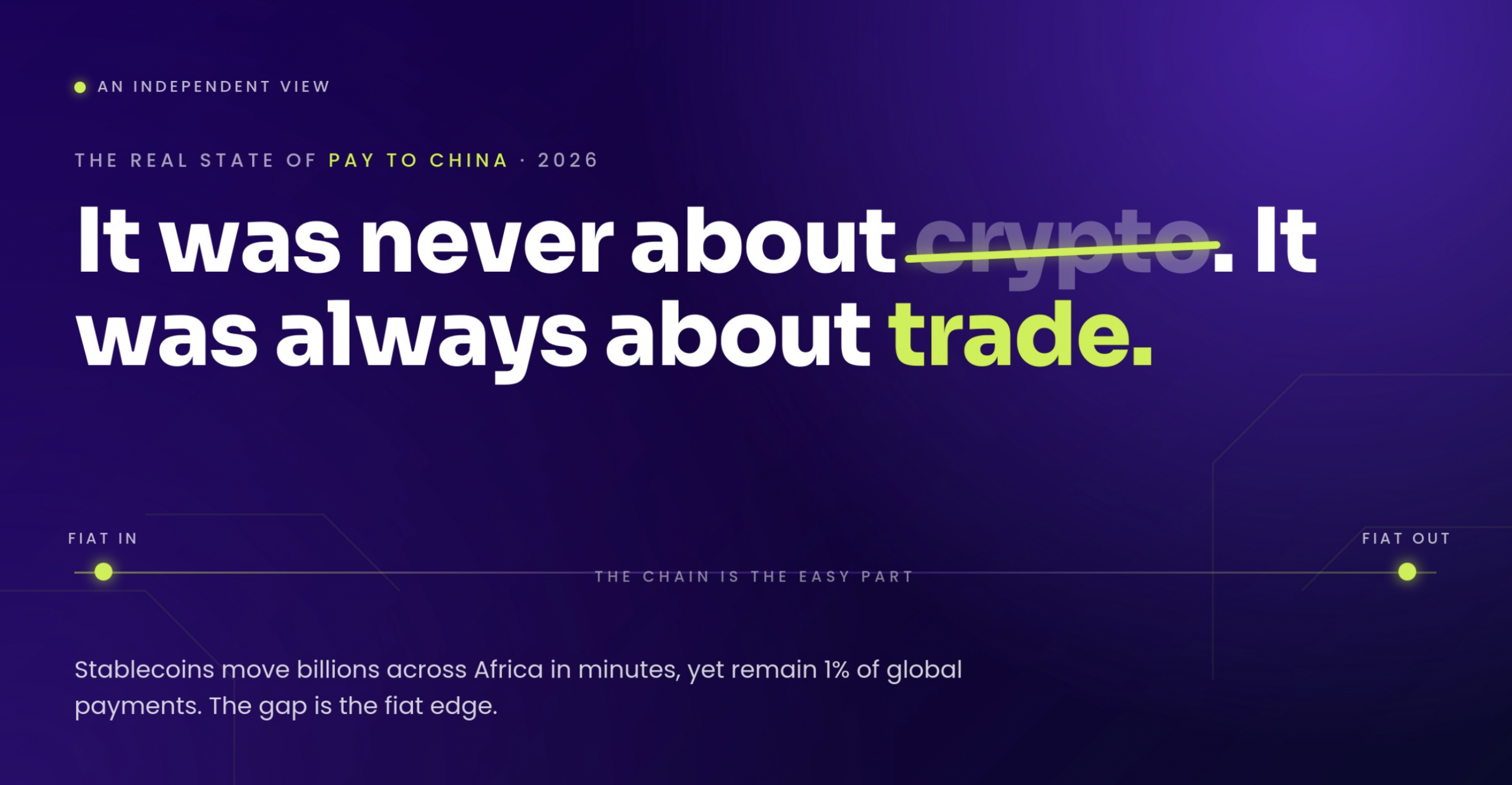
Here is the part that gets far less attention. Despite all that volume, stablecoins still sit at roughly 1% of global payment flows, a share that has barely moved since 2023, and less than 1% of the world’s cross-border payment flows by FXC Intelligence’s count.
Both facts are true at the same time, and the gap between them is, for my money, one of the most interesting stories in payments right now. The technology has won the argument. The infrastructure around it has not caught up. Below is my walk through where the stablecoin route to paying China actually stands in 2026, and why I think the next phase gets decided at the fiat edge, not on the chain.
What paying China with stablecoins actually means
Strip away the vocabulary and the model is simple. A business initiates a payout, and instead of the money routing through a chain of correspondent banks to a bank account, it settles to a blockchain wallet in a stablecoin such as USDT, USDC, or, here in Nigeria, cNGN. The full version is what the industry now calls the stablecoin sandwich: fiat in, stablecoin in the middle for the cross-border leg, fiat out on the other side. The stablecoin is the filling. The two slices of bread, the fiat on each end, are the parts everyone actually has to eat.
An example makes it concrete. Take an importer in Lagos paying a supplier in China. The traditional route sends naira through a bank, out through one or more correspondent banks, across a settlement window that only opens on business days, and into the supplier’s account three to five days later, with fees and an FX spread taken at almost every hop. The stablecoin route converts the naira to a dollar stablecoin, moves it on-chain in minutes at any hour of any day, and converts it to yuan on the other side. Same trade, same two businesses, completely different plumbing.
For the businesses involved, the difference is not cosmetic. It is working capital. Money that spends three days in transit is money you cannot use, and money you pre-position in foreign accounts “just in case” is capital sitting idle. OpenFX estimates the pool of capital trapped in pre-funded accounts globally at around $10 trillion. That is the firm’s own estimate and you can quibble with the number, but anyone who has watched a treasury team juggle pre-funding across four markets knows the underlying problem is real.
The four trend lines I am watching
B2B has become the centre of gravity. For years the stablecoin story was retail: traders hedging, individuals protecting savings, a long tail of informal WhatsApp channels running on trust. That has flipped. A January 2026 white paper from BCG and Allium found that B2B payments now make up about 40% of real-economy stablecoin volume and are growing at about 65% per year. The growth is coming from treasury teams, supplier settlement, and intercompany funding, exactly the flows where correspondent banking hurts most, especially on weekends and holidays when traditional rails simply close.
The incumbents stopped watching and started building. Visa’s stablecoin settlement pilot reached a $7 billion annualized run rate in April 2026, up 50% in a single quarter, across nine blockchains. Mastercard agreed to acquire stablecoin infrastructure firm BVNK for up to $1.8 billion, its biggest digital-asset deal to date. When the two largest card networks build settlement optionality on-chain, the stablecoin route stops being an experiment and becomes a product line.
Speed has overtaken cost as the reason institutions buy. The industry spent years pitching cheaper payments. What institutional buyers actually pay for, according to OpenFX’s 2026 report, is different: always-on availability, instant liquidity, and knowing where their money is at every step. Think of it the way you think about a flight versus a bus. You do not choose the flight because the ticket is cheaper. You choose it because your time, and here your capital, is worth more than the fare difference.
Africa is not following this trend, it is setting the pace. BVNK’s Stablecoin Utility Report 2026 puts stablecoin ownership among crypto-active users in Africa at 79%, ahead of roughly 60% in other emerging regions and about 45% in high-income markets. Chainalysis data shows sub-Saharan Africa received more than $205 billion in on-chain value between July 2024 and June 2025, up 52% year on year. And the driver is not speculation. It is need. The IMF notes that sending $200 to sub-Saharan Africa still costs about 9% of the transaction on average, against a global average of about 6%, per World Bank data. When the formal system charges you nine dollars to move two hundred, a rail that does it for cents is not a curiosity.
This was never really about crypto
Here is the uncomfortable part, and the reason stablecoins remain stuck around 1% of global flows despite everything above. The blockchain leg of a payment was solved years ago. Value moves across a chain in seconds. What has not been solved at scale is everything wrapped around it: converting local currency in and out reliably, sourcing liquidity in markets where dollars are scarce, screening transactions to the standard regulators expect, and reconciling on-chain settlement against off-chain books.
Go back to the Lagos importer. Her stablecoin reaches the supplier’s wallet in thirty seconds. Brilliant. But if the supplier then waits two days and pays a wide spread to turn that stablecoin into usable local currency, most of the advantage evaporates. The transfer was instant. The payment was not. This is why I think the off-ramp is not an accessory to the stablecoin route. The off-ramp is the product.
The IMF made a version of the same point from the regulator’s side. Adoption at Nigeria’s scale is testing the limits of existing frameworks, and the IMF’s advice was notably pragmatic: do not suppress, regulate and build. The markets that pair adoption with credible compliance and payment infrastructure will attract serious institutional volume. The ones that do not will stay stuck in the informal layer, big on volume, invisible to the businesses that need reliability.
We do not have to imagine what that looks like. Nigeria already ran the experiment on itself. In February 2021, the Central Bank of Nigeria barred banks from servicing crypto businesses. Did the volume disappear? No. It moved to peer-to-peer channels, beyond the view of banks and regulators, which is how Nigeria became one of the world’s largest P2P markets while officially having no crypto industry at all. In December 2023, the CBN reversed course and issued guidelines letting banks serve licensed virtual asset providers. By August 2024, the SEC had granted its first provisional licences to Quidax and Busha, and by March 2025, digital assets had legal recognition under the Investments and Securities Act. Four years from suppression to statute, and the volume was there the whole time. The only thing the ban ever changed was whether regulators could see it.
South Africa ran the control group. Its regulator opened crypto licensing in June 2023 and had approved 248 licences by the end of 2024, with banks openly serving crypto firms. The result, per Chainalysis, is one of the most institutionalised crypto markets in the region, with a high share of large-ticket flows. Same continent, same years, opposite postures, opposite outcomes.
So the winners of the next phase, in my view, will not be the chains, and probably not even the coin issuers. They will be the providers who own the fiat edge: licensed, locally connected, holding real liquidity in real corridors, able to make the settlement rail invisible to the businesses using it.
And here is the thing I want to leave you with, because it is where I am taking this next. Stablecoins are one way to pay China and reach that outcome. They are not the only way. You can get the same result, onshore payout, no pre-funding, always-on settlement, through a pure fiat rail that never touches a chain at all. The stablecoin route is an alternative, not the destination. I will write up that second route in a follow-up.
FAQ
What does it mean to pay China with stablecoins? Settling a payment to a supplier in China directly to a blockchain wallet in a stablecoin such as USDT, USDC or cNGN, instead of routing local currency through correspondent banks to a bank account.
What is the stablecoin sandwich? A cross-border payment model where fiat goes in on one side, a stablecoin carries the cross-border leg, and fiat comes out on the other side.
Why are stablecoins still only around 1% of global payments? The blockchain transfer is solved, but the fiat edge is not. Local currency conversion, liquidity, compliance screening, and reconciliation remain the binding constraints.
A note on this piece. I work in marketing in African fintech, so this is a space I follow closely and have opinions about. Those opinions are mine alone. Nothing here represents the position of my employer or any company I work with, none of it is a product claim or an offer, and none of it is financial, investment, or legal advice. Figures are drawn from the public sources named in the text and are current as of their publication dates. If you think I have gotten something wrong, tell me.