
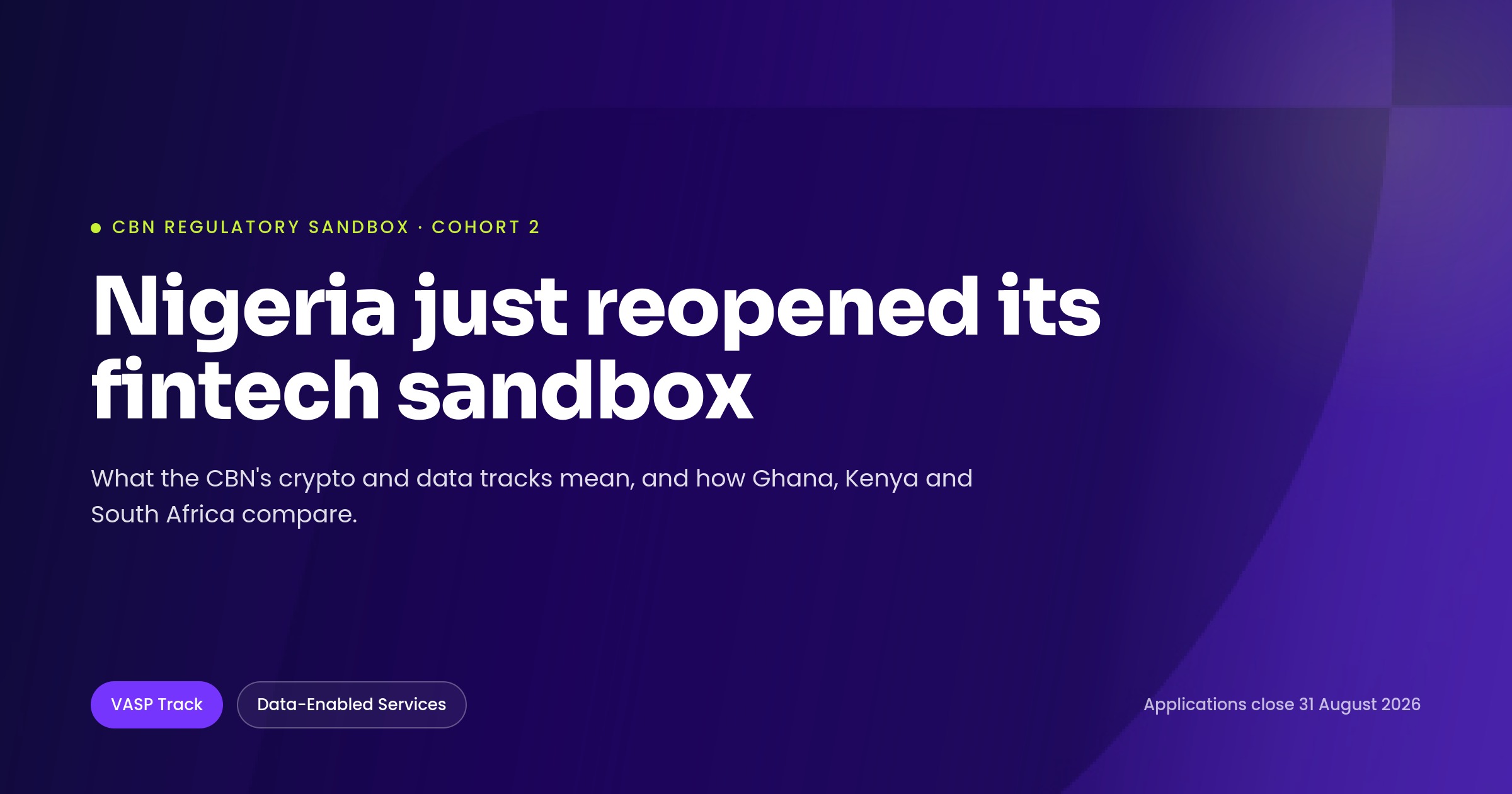
Hey, if you’ve been following Nigerian fintech or crypto at all, you probably saw the news: the Central Bank of Nigeria just launched Cohort 2 of its Regulatory Sandbox. Applications opened on 12 August and close on 31 August 2026. That’s a tight three-week window.
So what does this actually mean in plain English?
What even is a regulatory sandbox?
Think of it as a supervised playground. Companies can test new financial products and ideas with real customers, but under the CBN’s watch and with clear limits (how many users, how much money, how long, etc.).
It’s not a full licence. You don’t get to go wild and operate freely (slow down, Barry Allen). You test, the regulator watches and learns, and both sides figure out what works and what needs rules. When the test ends, you still have to apply for proper licences if you want to scale.
The two CBN sandbox tracks: VASP and Data-Enabled Financial Services
1. The VASP Track (Virtual Asset Service Providers)
This is the one that got people talking. It covers virtual assets, stablecoins, crypto payments, settlement, custody, wallets and related stuff.
Nigeria has one of the biggest crypto scenes in Africa. For years the CBN was quite strict about it. Now they’re saying: come and test these things properly under our supervision so we can understand the risks and write better rules. Big deal for anyone building stablecoin payment tools, custody solutions or crypto infrastructure.
2. The Data-Enabled Financial Services Track (Non-VASP)
This one is about using data smartly and safely. Think open banking-style data sharing, better credit scoring with alternative data, fraud tools, risk analytics, and products that make payments or financial services work better for more people.
Basically, if your idea uses permission-based data to improve inclusion, credit access or efficiency without being a pure crypto play this is your lane.
Why the CBN Regulatory Sandbox matters
Nigeria is trying to move from “ban first, ask questions later” toward “let’s test carefully and then regulate properly.” The sandbox lets innovators try things without immediately breaking the law, and it gives the CBN real evidence instead of theory. For software engineers reading, think about it as a staging branch.
Quick note on where I sit in this, I work at Fincra, which builds the cross-border payment and settlement infrastructure a lot of these products run on. So when a stablecoin or payments company clears a sandbox and needs to move money across African markets, collect locally, pay out locally, settle reliably, that is the part we handle. The sandbox is about permission to test. We are about whether the money moves once you do.
Successful applicants will still have to put strong consumer protection, cybersecurity and reporting systems in place. And again being in the sandbox is not the same as being licensed to operate fully.
How does this compare to other African countries?
Ghana is a very close parallel. The Bank of Ghana has been running its own sandbox for a few years and recently brought in a group of companies specifically to test virtual assets (exchange, custody, issuance, etc.). Ghana also passed a Virtual Asset Service Providers law, so they’re further along the formal regulation path in some ways.
Kenya has had a capital-markets sandbox for years and several companies have already graduated from it. South Africa runs a multi-regulator sandbox and has tested things like crypto remittances and digital asset custody. Rwanda has been quietly positioning itself as a friendly testing ground too.
Across the continent the pattern is similar: regulators are shifting from outright restrictions toward controlled testing and eventual licensing. Nigeria’s dual-track approach (crypto + data) is pretty smart for where the market is right now.
This is the layer Fincra works in. We run licensed cross-border collection, payout and settlement infrastructure across 15+ African markets, including Nigeria. That is the plumbing a stablecoin or payments company needs the moment it moves from a sandbox test to real volume. The sandbox decides who gets to test. The rails decide whether the product actually works once they do.
The bottom line
If you’re building something innovative in virtual assets, stablecoins, or data-driven financial services, this is a rare chance to test under the CBN’s eye. The window is short, the bar is about readiness and risk management (not just a cool idea), and getting in is only the first step.
But you might need to ask yourself, “do I really want CBN to add me on their radar?”
For the rest of us watching from the sidelines, it’s a clear signal that Nigeria is trying to get more serious and more structured about the future of digital finance without throwing consumer protection or financial stability out the window.
Applications go through the official portal at sandbox.cbn.gov.ng. If this is relevant to you, move fast. Three weeks disappears quickly.
Want to see how the money actually moves once a product is past the testing phase? Read our breakdown of the state of cross-border payments between Nigeria and China, where we look at the routes companies use today, including the crypto off-ramp.