
It’s an ordinary Nigerian bank transfer: you send ₦15,000 to your sister at another bank, and before you’ve locked your phone she replies, “Got it, thanks.” It feels like the money went straight from your account to hers. It didn’t. At that moment, your bank hasn’t paid her bank a kobo.
That gap is how almost every Nigerian bank transfer has worked since 2011. Now NIBSS (Nigeria Inter-Bank Settlement System), the company that runs the rails between Nigerian banks, is replacing the system behind it.
This piece follows one transfer from your app to your sister’s account, then looks at what the new system changes.
How a Nigerian bank transfer moves today
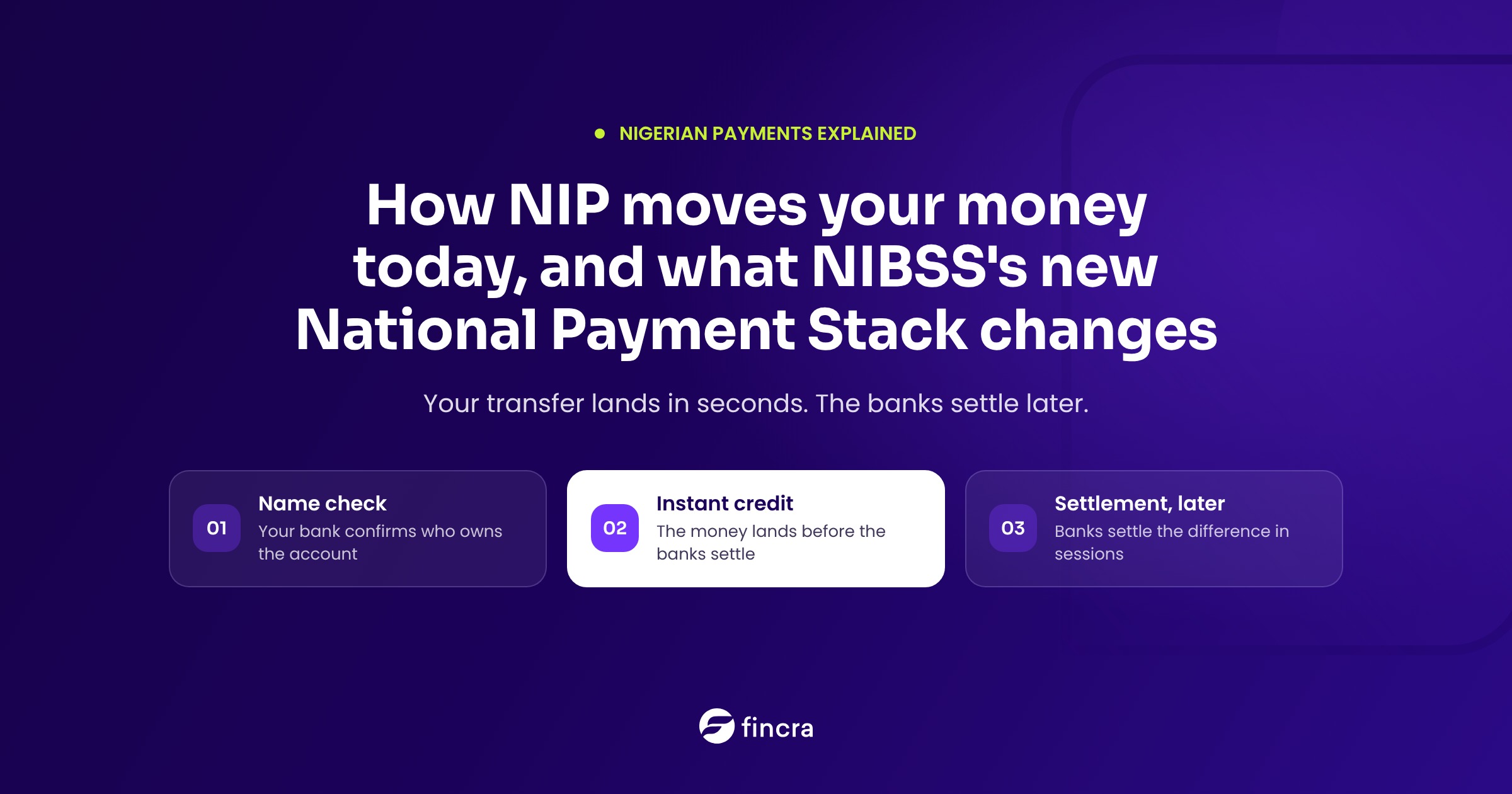
Most transfers between Nigerian banks run on NIP, short for NIBSS Instant Payment. NIBSS launched it in 2011 (Paystack). Your ₦15,000 goes through three stages.
1. The name check
You type your sister’s 10-digit account number, pick her bank, and her name pops up. That’s a name enquiry: your bank asks her bank, through NIP, who owns the account (NIBSS). It’s the step that stops you sending money to a stranger because you swapped two digits.
2. The message
When you tap send, your bank takes ₦15,000 from your account and sends a payment instruction through NIBSS. NIP passes it to her bank straight away, and her bank credits her (NIBSS). This is the part you see.
3. The settlement, later
The part you don’t see comes later. NIBSS describes NIP as a deferred net settlement system: your sister has the money before the two banks settle up (NIBSS). NIBSS runs 12 settlement sessions for NIP. At each one, banks settle what they owe each other through their accounts at the Central Bank of Nigeria (NIBSS, Paystack).
Think of friends who keep a running tab at a bar and settle at the end of the night instead of paying for every round. If one bank’s customers sent ₦10 billion to another bank’s customers since the last session and received ₦9 billion back, only the ₦1 billion difference has to move. (Those figures are only an example.)
Splitting the message from the settlement is what makes transfers feel instant (Paystack). Microfinance banks, fintechs and other institutions without their own clearing house account settle through a settlement bank (NIBSS).
The next Nigerian bank transfer rail: the National Payment Stack
NIBSS unveiled the National Payment Stack (NPS) in June 2025 as the platform that comes after NIP (NIBSS). It’s already running. In August 2026, NIBSS reported that NPS had processed 26.55 million transactions worth ₦1.4 trillion across 48 participating institutions. Its managing director, Premier Oiwoh, said NIBSS was preparing to decommission “our 15-year-old legacy NIP rail” (NIBSS).
In October 2026, NIBSS said it built NPS on Transactility’s jPTS switch, which runs on jPOS, an open-source framework for processing payments (Nairametrics). NIBSS has used jPOS for years and has access to the source code, so it can shape the platform itself rather than wait on a vendor (Nairametrics, ThisDay).
What changes for a Nigerian bank transfer
Payments that say what they’re for
Picture a small business that gets 40 transfers in a day, half of them with the narration “payment”. Someone in finance then has to work out who paid for what. NPS uses ISO 20022, an international standard for payment messages, and NIBSS says it can carry structured details such as invoice numbers and the purpose of a payment (NIBSS).
Paying a phone number
NIBSS’s October statement lists payments addressed to a phone number (Nairametrics). In practice, you could pay your tailor using the number already saved in your phone, instead of asking for an account number and a bank name.
QR codes, bulk payments and payment requests
The same statement lists QR code payments at merchants and bulk payments (Nairametrics). NIBSS also lists request-to-pay and direct debit among the NPS features (NIBSS). Request-to-pay lets a business send you a payment request to approve, instead of waiting for you to remember to pay.
What we still don’t know
NIBSS hasn’t given a date for switching off NIP (NIBSS). Banks and fintechs already on NIP have to integrate with NPS separately, because it uses a different message format (NIBSS). Until they do, both rails run side by side.
Settlement is the other open question. NIBSS listed “immediate settlement” when it unveiled NPS (NIBSS), but its August update also mentions deferred settlement options (NIBSS). Until NIBSS publishes more detail, it isn’t clear whether the running tab goes away.
What this means for businesses
If you run a shop, phone-number and QR payments could mean fewer transfers to the wrong account and fewer minutes at the counter waiting on “Have you sent it?”
If you run finance, the payment data matters more. Matching a ₦250,000 credit to the right invoice is much easier when the payment carries the invoice number.
If you move money across borders, a domestic rail that uses the same message standard as many international systems means fewer format conversions in between. We covered why the rails underneath matter in Modern Rails for Africa’s Economy, and how a different Nigerian payment works in how Google Pay works in Nigeria.
What it means for your next Nigerian bank transfer
Your transfers feel instant because NIBSS splits the message from the settlement. NPS keeps that speed and adds richer payment data, phone-number payments and a platform NIBSS controls. When you notice the difference depends on how fast banks connect, and when NIP is switched off.
At Fincra, we work with these rails from the business side: one API to collect by card, bank transfer and other local payment methods across African countries. See how Fincra collections work.