

AI-powered fraud in payments is no longer a future risk. Your finance team just received an urgent wire request. The email looks exactly like it came from your CEO. The tone, the phrasing, the sign-off: all of it matches. There is only one problem: your CEO did not send it.
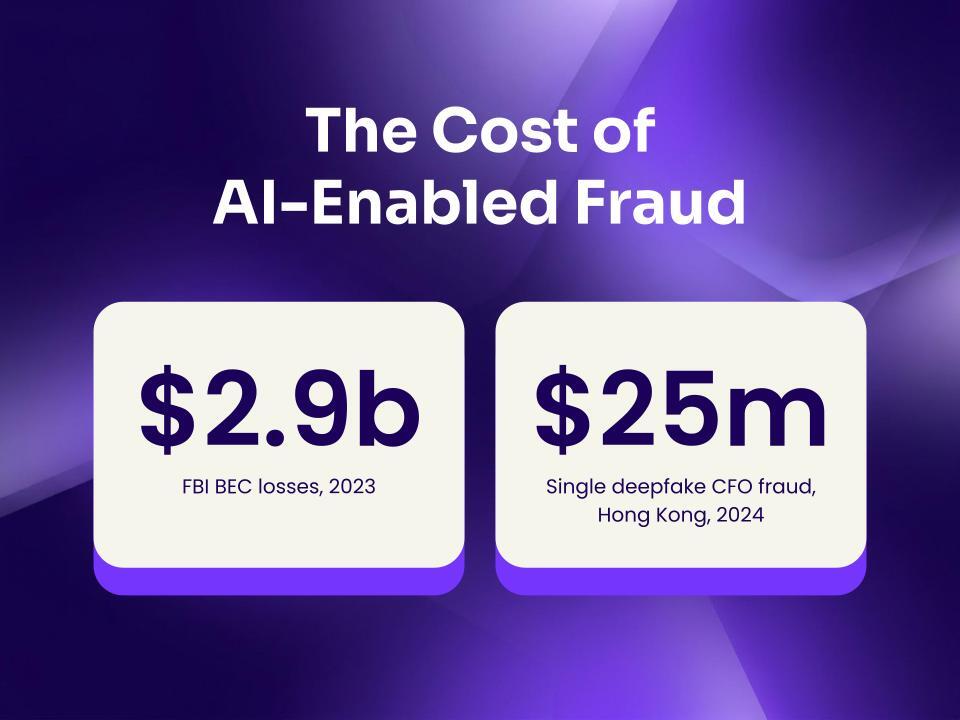
This is not a hypothetical. Business email compromise attacks using AI-generated content cost businesses $2.9 billion in 2023, according to the FBI’s Internet Crime Complaint Center, with losses growing year on year as the quality of AI-generated communications improves. In 2026, AI-powered fraud in payments is not a future threat for businesses to prepare for. It is the current operating environment.
This article covers what AI-powered fraud actually looks like in practice, why it is harder to detect than traditional fraud, and what payment businesses and financial institutions can do to build meaningful defences.
How Fraudsters Are Using AI-Powered Fraud in Payments
The important thing to understand about AI-powered fraud is that it does not change the fundamental goals of fraud. Specifically, the goals are the same: stealing money, extracting credentials, and gaining access to accounts. What AI changes is the speed, scale, and believability of the attacks used to achieve those goals.
Hyper-Realistic Phishing and Business Email Compromise
Traditional phishing emails were relatively easy to spot: generic phrasing, mismatched email domains, spelling errors, and requests that did not reflect how your organisation actually operates. Large language models have removed most of those tells.
AI can now analyse a target’s publicly available communications, social media presence, and writing style to produce emails that match their tone precisely. For businesses, this means a fraudulent request that reads exactly like the CFO who wrote it, because it was trained on emails the CFO actually wrote. The FBI’s 2024 Internet Crime Report documented over 21,000 BEC complaints in the US alone, with total losses exceeding $2.9 billion in that year. As a result, the AI-generated variant of this attack is harder to detect and faster to deploy at scale.
Deepfake Voice and Video
In early 2024, a finance employee at a multinational firm in Hong Kong transferred $25 million after attending a video call with what appeared to be the company’s CFO and several colleagues. Every person on the call was a deepfake. The employee had no reason to suspect anything was wrong until after the transfer was made.
AI voice cloning tools can now produce a convincing replica of a person’s voice from as little as three seconds of audio. McAfee research found that 77% of voice cloning scam victims lost money, with one in four adults reporting they had been targeted. For payment businesses, the implication is clear: a phone call from a known executive authorising a transaction is no longer a reliable verification method on its own.
A phone call from your CEO is no longer verification. AI can replicate a voice from three seconds of audio. The procedures your team trusts need to reflect that reality.
Automated Attacks at Scale
Beyond targeted fraud, AI enables automated attacks that were previously impractical at volume. Fraudsters use AI to generate synthetic identities, which are combinations of real and fabricated personal data, that pass initial KYC checks. In addition, the same tools run credential stuffing attacks that adapt in real time when security systems push back, testing account access attempts faster and more intelligently than human operators could.
For payment processors and platforms, this means fraud that adapts to your defences as quickly as you build them. An attack that fails today looks different tomorrow, because the system generating it learns from each failure.
Advanced Social Engineering
AI chatbots can now sustain extended, context-aware conversations that impersonate customer support agents, bank representatives, or compliance officers. These are not scripted phishing attempts. They are live, adaptive conversations designed to build trust over time and extract credentials, account details, or authorisation for fraudulent transfers.
The target of these attacks is often not a payment system directly, but the humans who operate it. A customer support agent who believes they speak with a compliance team member may voluntarily provide access that no automated system could extract.
How to Stay Ahead of AI-Powered Fraud in Payments
The response to AI-powered fraud in payments is not primarily a technology problem, though technology is part of it. It is an operational problem: do your verification processes, your team’s training, and your system architecture reflect the actual threat environment your business operates in?
Strengthen Verification at Every Layer
Multi-factor authentication is the baseline, not the ceiling. For high-value transactions, dual approvals, out-of-band verification, and behavioural analytics should sit on top of MFA. The principle is simple: any single verification method that an AI system could spoof should have a second method that requires a different kind of confirmation.
For high-risk scenarios such as wire transfers above defined thresholds, changes to beneficiary account details, and executive approval requests. The verification process must be explicitly documented and enforced. A written procedure that requires a video call for transfers above a threshold provides almost no protection if your team does not know that deepfake video calls are a documented fraud vector.
Fight AI with AI: Detection and Monitoring
Signature-based fraud detection systems were built to catch known fraud patterns. However, AI-generated fraud does not follow known patterns; it generates new ones continuously. The response is AI-powered anomaly detection: systems that establish a baseline of normal transaction behaviour and flag deviations in real time, rather than matching against a list of known bad actors.
For payment platforms, this means monitoring transaction timing, velocity, geolocation patterns, device fingerprints, and counterparty behaviour together, not in isolation. A single unusual data point is noise. A cluster of unusual data points at the same time is a signal worth investigating.
Signature-based fraud detection was built for yesterday’s fraud. AI-powered fraud does not follow known patterns; it generates new ones. The detection layer needs to match.
Secure Your APIs and Integrations
Payment infrastructure depends on APIs. APIs are also a primary attack surface. Strong authentication, rate limiting, and continuous monitoring of API behaviour are not optional features for payment businesses. They are the difference between an integration that is compliant and one that is exploitable.
Credential exposure through compromised API keys is one of the most common vectors for payment fraud at scale. Therefore, regular rotation of credentials, strict access controls, and automated alerting on unusual API behaviour patterns close this surface significantly.
Train Your Team on Current Threats
Security awareness training that covers phishing in general is no longer sufficient. Your team needs to understand what AI-generated phishing looks like specifically, what deepfake voice and video calls sound and look like, and what the correct procedure is when something feels wrong, even when it looks legitimate.
Verification procedures for high-risk requests should be simple enough to follow under pressure. If the procedure requires more steps than an employee will take in a busy moment, it will not be followed. The goal is not a perfect procedure that no one uses. It is a practical procedure that becomes a reflex.
Adopt Zero Trust Architecture
Zero Trust is the security principle that no request, internal or external, is automatically trusted. Every access request gets verified. Permissions are granted at the minimum level required. Unusual access patterns trigger review rather than silent approval.
For payment businesses, Zero Trust matters most at the edges of the system: the API connections, the third-party integrations, the human approval workflows, and the communication channels used to authorise transactions. Forrester Research consistently identifies Zero Trust as the most effective architectural response to the class of threats that includes AI-powered fraud, because it removes the assumption that being inside the perimeter means being safe.
What This Means for Payment Infrastructure
The businesses most exposed to AI-powered fraud in payments are not those with the weakest technology. They are the businesses whose verification processes, team training, and system architecture have not kept pace with the threat environment. Consequently, a payment platform built on strong, monitored infrastructure with clear human verification procedures is significantly more resilient than one where controls were designed for a pre-AI fraud landscape.
At Fincra, security and compliance are built into the infrastructure layer, not bolted on top of it. If you are a payment business, bank, or corporate treasury team re-examining your fraud posture in 2026, speak to the team.

